Tattoos and Fashion Empower Self-Expression
A look into how style and body art allows individuals to express their identity, individuality and why this matters in today’s society.
By: Camille Oriti
Story highlights:
According to psychologists, the freedom to express yourself through clothing, or tattoos can help people find a sense of belonging in communities and within themselves.
Most Americans say society has become more accepting of people with tattoos - 8 in 10 Americans say society has become more accepting of people with tattoos. (Pew Research, 2023)
Fashion and style serves as an expressive medium for people to communicate meaning. “The memories and meanings that come with tattooing allows so many people to express themselves,” Tattoo Artist Cris Sapien said.
SAN DIEGO - For generations, fashion and personal style has served as an expressive medium for people to communicate their personalities and identities. Beyond aesthetics, these forms of self-expression help people embrace their creativity and showcase who they truly are. One art form and fashion expression is tattooing.
The art of tattooing has existed for thousands of years as an ancient tradition in cultures around the whole world. Tattoos date back about 5,000 years with the earliest known tattoos to be found on mummified human remains. Tattoos have always been seen as an art form and a way to carry significant meaning for many people. Tattoos and other means of style are becoming more common, even in the workplace. In fact, according to Pew Research, “32% of Americans have a tattoo, including 22% who have more than one.”
Pixleys Oddities is a queer femme-owned and operated tattoo and piercing shop in San Diego since October 2021. Nestled in the North Park neighborhood of San Diego, the pink doors welcome customers into a colorful and artistic shop filled with a mix of taxidermy, trinkets, sonny angels and of course tattooing.
For Cris Sapien, a tattoo artist for Pixley Oddities since 2024, tattooing has always been a part of her life and story. Born and raised in Mexico, Sapien began tattooing in May 2022, where she apprenticed in El Paso, Texas.
Sapien’s inspiration for tattooing started with her father-in-law, when she and her husband wanted to learn.
“During COVID, since we had nothing to do, we were like what if we asked him to teach us how to tattoo? So let’s just try it and we just never looked back, honestly,” Sapien said.
For Sapien, being an artist has always been a part of her life. She expresses how she enjoys the challenge of constantly being able to do something different.
“If I do something repetitively, I don’t want to do it.”
Tattooing offered Sapien the opportunity to be able to combine her social skills with her artistry. She also loves the opportunity to meet such interesting people and have conversations with them.
“I think a lot of people find it therapeutic to get tattooed,” Sapien says.” A lot of times I just let them talk. So I think that my favorite part is talking to people.”
One of the things that stands out about tattooing as a form of self-expression to Sapien is the ability for tattoos to represent something meaningful or significant to them. As someone who has several meaningful tattoos with connections to her loved ones, pets, and hobbies, Sapien says the memories and meanings that come with tattooing allows so many people to express
themselves.
themselves.
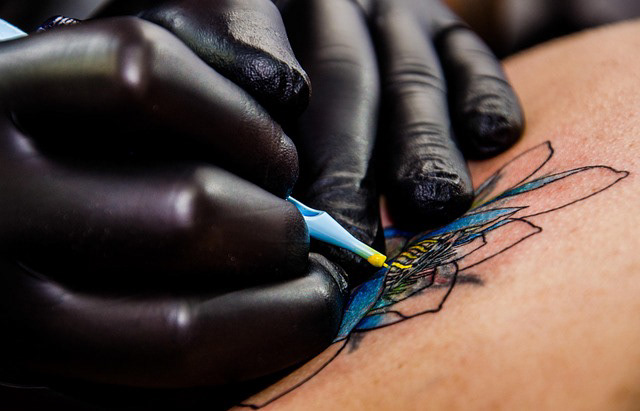
An up close tattoo being done on a woman. Photo by Marcelo Bragion from Pixabay
Communities Are Changing How Society Sees Self-Expression and Tattoos
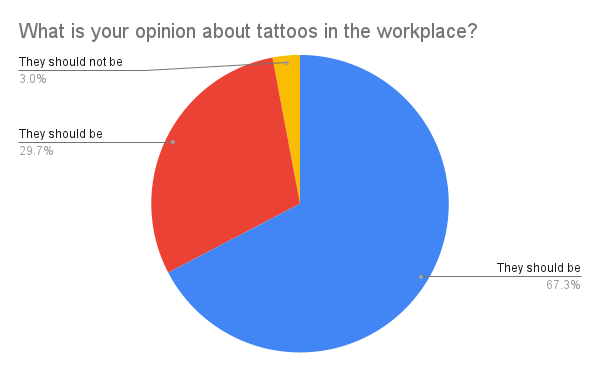
Above is an infographic that showcases data from a survey conducted between Nov. 3 and Nov. 18, by this reporter regarding individual’s perceptions about tattoos and their representation in society.
The survey contained a few different polls asking individuals, “What is your opinion about tattoos in the workplace?” Of the 101 participants from the survey, about 67% said they should be allowed freely/openly, 29% said they should be regulated, and 3% said they should not be allowed at all. The majority of voters in this poll voted that tattoos should be allowed freely/openly.
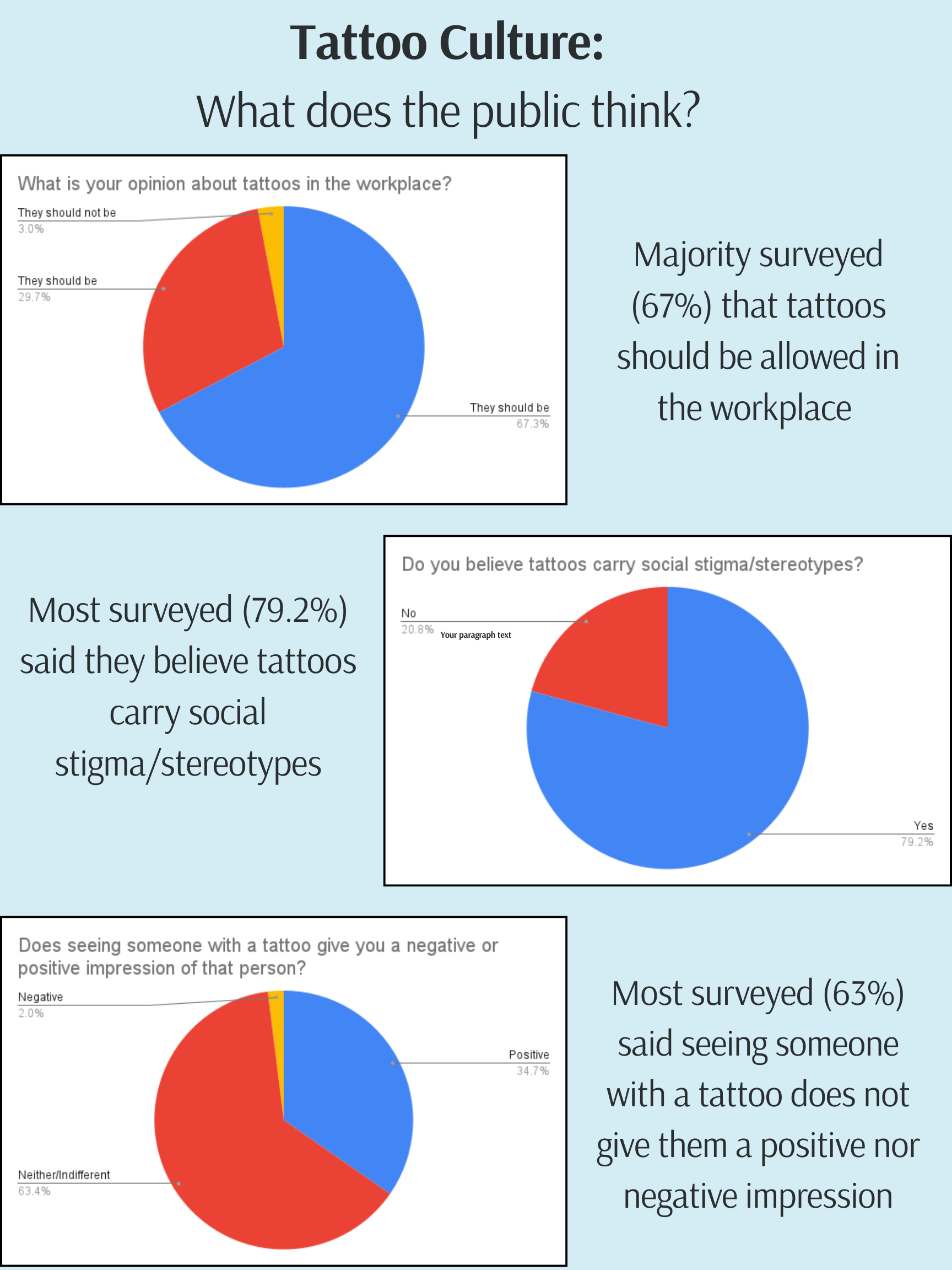
Out of the 101 participants, 20.8% people believe that tattoos do not carry social stigma/stereotypes, while 79.2% people said tattoos do carry social stigma/stereotypes. 34.7% people said seeing someone with a tattoo gives them a positive impression, 63.4% say seeing someone with a tattoo does not give them a positive nor negative impression, but indifferent, and 2% says seeing someone with a tattoo gives them a negative impression.
According to a 2023 study by Pew Research Center, Americans overall – including those with and without tattoos – believe society has become more accepting of people with tattoos over the past 20 years or so. Approximately 8 in 10 Americans say society has become more accepting of people with tattoos, while 7% say society has become less accepting of tattooed people. Another 12% say societal acceptance of people with tattoos has stayed about the same over the past two decades.
As tattoo culture continues to evolve, many more people have become more accepting of tattoos, particularly in the workplace and professional settings, while others believe it is dependent on the situation and company.
When people aren’t able to express themselves authentically, there may be feelings of loneliness and frustration. It is common in society to question how we 'should' behave, what stereotypes we 'should' conform to, what we ‘should’ wear, etc.
Despite the stigma and negative stereotypes around tattoos, more than 40% of millennials — people born between 1981 and 1996 — have a tattoo, according to market research firm Ipsos. This is compared to just 13% of baby boomers who have a tattoo.
Self-expression offers people comfort, independence, and creativity. It also plays a vital role in improving mental and emotional well-being for many individuals. It nurtures connection and community, as it allows people to relate to one another and find their niche.
The Art of being yourself and the stories people carry
For many people with tattoos, it is a form of therapy and even a tool for trauma survivors. It is a way to showcase who they are as a person, and the things and people they love.
Kamryn O’Malley is a tattoo artist at Locally Famous Tattoo in San Marcos, California. O’Malley’s love for tattoos started as she grew up accompanying her mom to her tattoo appointments. This began her attraction to the art form, where she later decided it was going to be her career path.
“What finally solidified tattooing as my career was the pure joy and satisfaction my clients would get after each session,” O’Malley said.
For O’Malley, tattooing is one of the many special art forms.
“The fact that tattooing goes so far back in history, it feels like something that can never die. It’s everlasting, it’s one of the most permanent decisions you can make,” O’Malley said. “No one can claim that they invented it came up with a design. This art craft has been around for so long that everything is just an adaptation of another.”
Tattoos are increasingly being recognized as an art form. Tattoos have played a significant role in American counterculture and subcultures, from the rebellious bikers of the 1950s to the punk and grunge scenes of the 1980s and 1990s. In these subcultures, tattoos were often used as a form of self-expression and resistance against mainstream society.
“I feel that tattoos are one of the most unique ways of showing self expression,” O’Malley said. “Even if the tattoo itself doesn’t have a particular meaning, the style/placement/size can play into that person’s persona. As for me I have just a few tattoos that have meaning. A few on my back for my dad and one on my ribs for my mom.”
When talking about stigma, O’Malley says she believes the stigmas and stereotypes around tattoos have become much less relevant.
“Especially with the ongoing flow of women joining the industry, tattoos are being seen in a different light due to the increasing professionalism of the industry, “ O’Malley said. “Majority of people that still have negative opinions towards tattoos are a part of the older generation.”